
The research
More nutrientsper spoon.
Five of the seven microgreens in TrueMicro were assayed in a study published in the Journal of Agricultural and Food Chemistry.
Microgreen vs mature plant
The gap, drawn to scale.
Each pair below uses the values published in the study. The bar length is exactly proportional to the milligram concentration.
Red Cabbage
Vitamin C
· In TrueMicro
Red cabbage microgreen
147 mg/100g
Mature red cabbage
24.4 mg/100g
6×
Microgreen advantage
Daikon Radish
Vitamin E
· In TrueMicro
Daikon radish microgreen
127 mg/100g
Mature spinach reference
2.2 mg/100g
~40×
Microgreen advantage
Cilantro
Lutein + Zeaxanthin
Cilantro microgreen
10.1 mg/100g
Mature cilantro
0.9 mg/100g
11×
Microgreen advantage
Red Cabbage
β-Carotene
· In TrueMicro
Red cabbage microgreen
11.5 mg/100g
Mature red cabbage
0.044 mg/100g
260×
Microgreen advantage
Source: Xiao, Lester, Luo, Wang. J. Agric. Food Chem. 2012, 60, 7644–7651.Mature-stage values are pulled from the same study where measured, and from the USDA National Nutrient Database otherwise. That’s the same comparison set the study itself uses.
Ingredient by ingredient
Five of the seven, named in the study.
Five microgreens in TrueMicro were assayed. The other two are well-studied brassicas in the same family. Both are flagged below.
Hero ingredient
Red Acre Cabbage
0mg / 100gvitamin C
6× the vitamin C and 40× the vitamin E of mature red cabbage.
Tops the entire 25-variety study for vitamin C. 260× the β-carotene of the mature head.
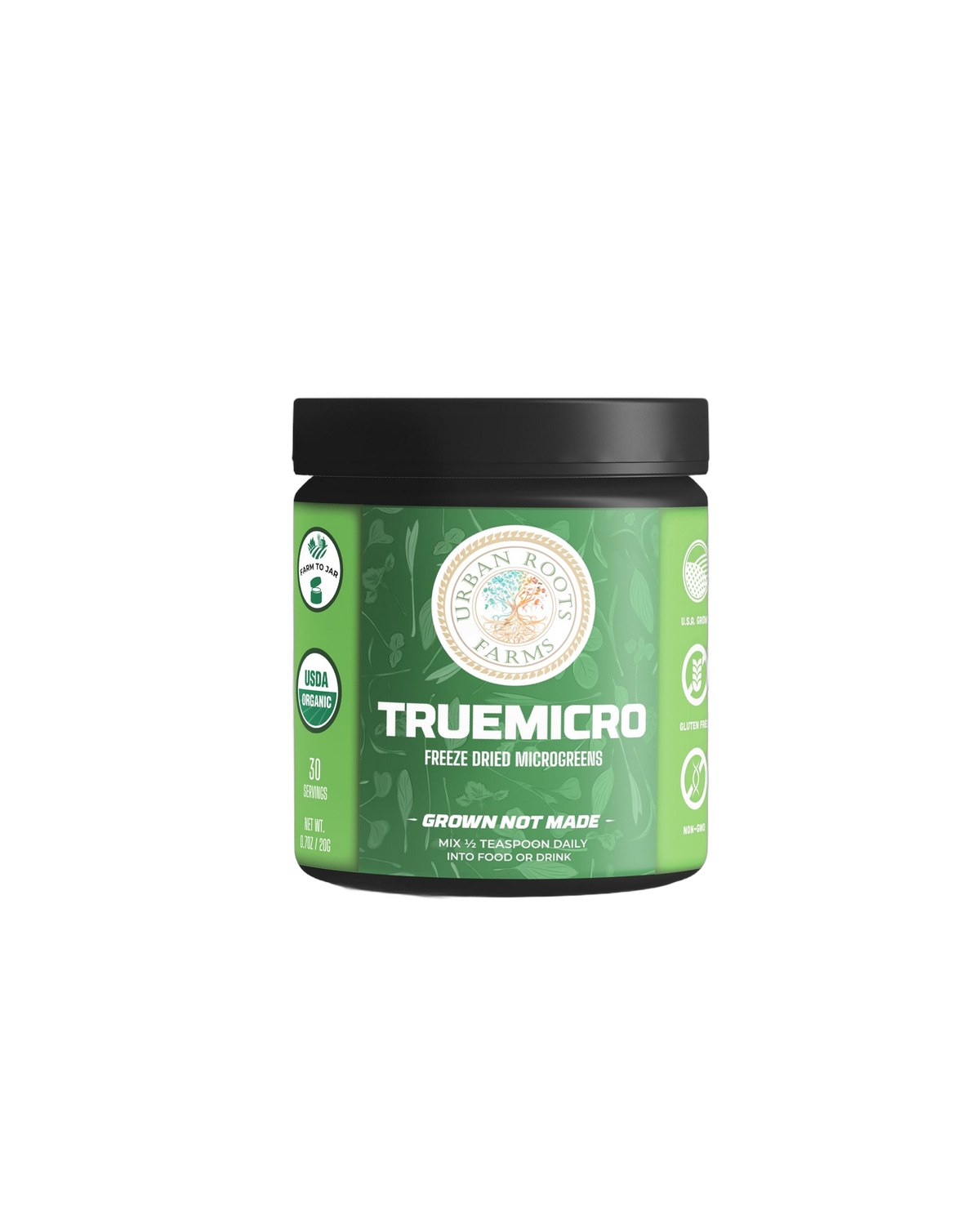
The jar they power
TrueMicro
Seven peak-harvest organic microgreens, freeze-dried whole.
Shop the jarRambo Radish
0mg / 100gvitamin E
Highest vitamin E of all 25 microgreens tested.
Tens of times higher than mature spinach.
Pea Tendrils
0.0µg / gvitamin K1
K1 on par with broccoli, the leading K1 vegetable.
Plant protein + K1 for bone and cardiovascular support.
Arugula
0.0mg / 100gβ-carotene
A multi-vitamin in a single peppery green.
Vitamin C, vitamin E, and β-carotene all measured.
Detroit Dark Red Beets
0.0µg / gvitamin K1
Pigment up top, vitamin K1 underneath.
Betalains for liver detox, K1 for circulation.
Broccoli
The K1 benchmark the study measures against.
18 of 25 microgreens equal or exceed mature broccoli on K1.
Kale
Brassica family, dense by design.
Vitamin C, E, and β-carotene all jump at the microgreen stage.
HPLC vitamin K analysis · schematic
Detection at 270 nm · C18 column · 1.0 mL/min
Schematic representation of the HPLC vitamin K analysis described in the cited study. Two characteristic peaks: menaquinone (K₂) used as the internal standard, and phylloquinone (K₁) measured in microgreen extracts. Reference method: Xiao et al., 2012, Materials and Methods.
Assessment of Vitamin and Carotenoid Concentrations of Emerging Food Products: Edible Microgreens
Zhenlei Xiao, Gene E. Lester, Yaguang Luo, Qin Wang. Journal of Agricultural and Food Chemistry, 2012, 60, 7644-7651. DOI: 10.1021/jf300459b.
Open in journalYear
2012
Journal
J. Agric. Food Chem.
Sample size
25 varieties × 3 replicates
Funding
USDA-ARS
Two evidence streams, kept separate
What the research covers, and what AzLab covers.
Vitamin C, vitamin E, vitamin K1, β-carotene, lutein, violaxanthin
The published evidence base on the microgreen category. This is what clinicians and researchers cite when they talk about microgreen nutrient density.
Typical ORAC, polyphenol, glucosinolate concentrations
Independent third-party assay of finished TrueMicro and TrueMyco. We label each batch with its lot information so you can trace what’s in your jar.
ORAC, polyphenols, glucosinolates on finished TrueMicro & TrueMyco. Vitamin findings come from the peer-reviewed study. We keep these streams separate so neither is misattributed.
Further reading
Additional research we reference
Oxygen Radical Absorbance Capacity (ORAC) of Selected Foods — 2007
U.S. Department of Agriculture, Agricultural Research Service, 2007. ORAC values for 277 food items, measured in Trolox Equivalents per 100g. The reference dataset behind antioxidant comparisons.
Nutrient Data Laboratory, BHNRC, ARS, USDA. Oxygen Radical Absorbance Capacity (ORAC) of Selected Foods — 2007. U.S. Department of Agriculture, November 2007.
Open documentPeer-reviewed review — Molecules 2023Microgreens — A Comprehensive Review of Bioactive Molecules and Health Benefits
A comprehensive review of bioactive compounds in microgreens and their role in reducing risk of obesity, type-2 diabetes, cardiovascular disease, and other non-communicable conditions.
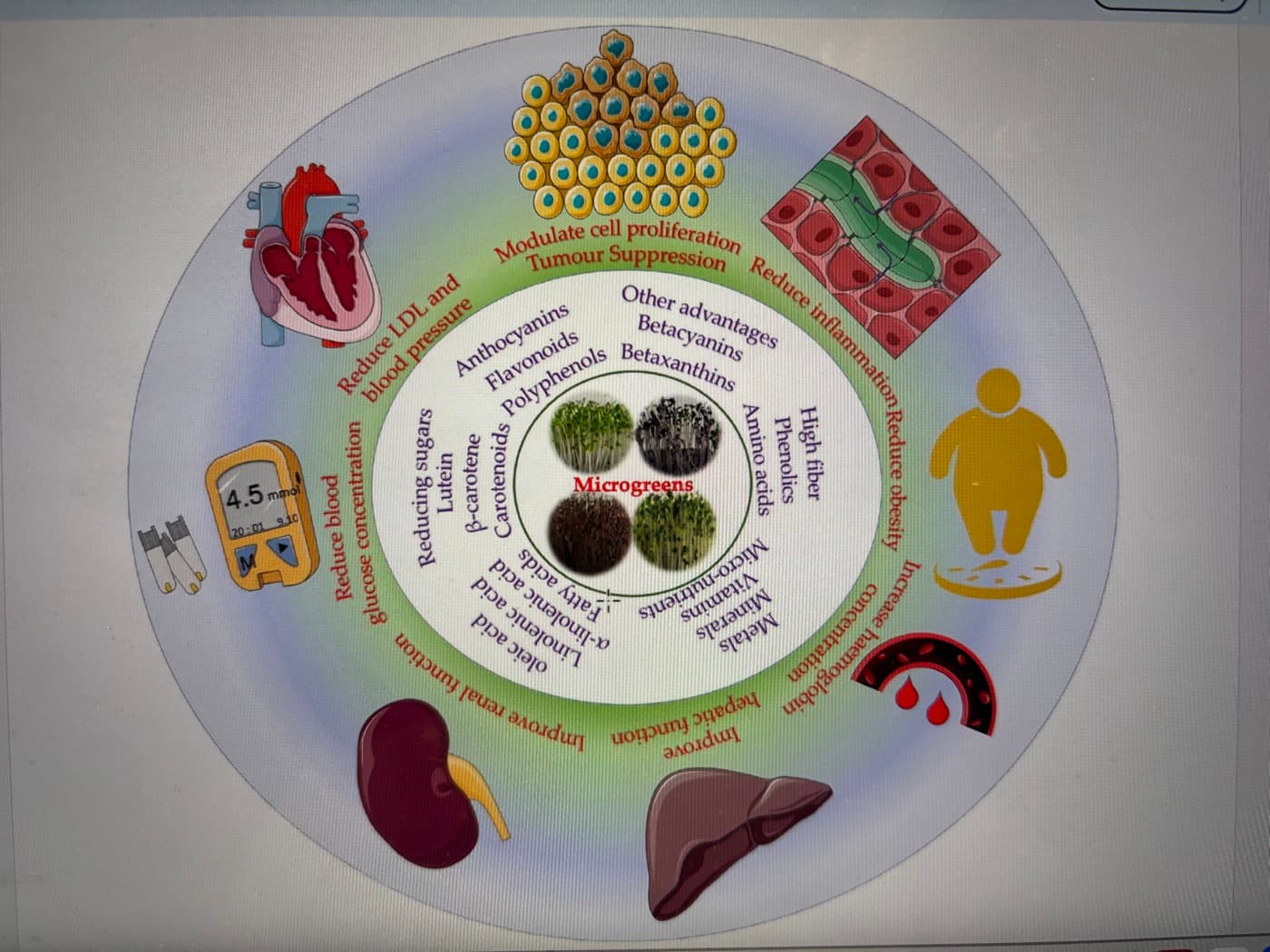
Bhaswant, M.; Shanmugam, D.K.; Miyazawa, T.; Abe, C.; Miyazawa, T. Microgreens—A Comprehensive Review of Bioactive Molecules and Health Benefits. Molecules 2023, 28, 867. DOI: 10.3390/molecules28020867.
Open in journalTry the formulation
Drink the powder behind the numbers.
Seven peak-harvest organic microgreens, freeze-dried into a single heaping half-teaspoon. The same vitamin density the study measured, in the jar on your counter.